

Soft tissue connect, surround or support internal organs and bones. They exhibit a large variety of microstructures and mechanical properties, which vary from organ to organ and according to patho-physiological conditions. In these tissues, cells are dispersed away from one another and in a collagen-based matrix, the so-called extra-cellular matrix (ECM). It is known that cells can rearrange the collagen both by biochemical action and mechanical forces, over the time scale of hours, and that their action can result in drastic changes in both the organisation and the mechanical properties of the matrix [1,2,3]. How cells collectively orchestrate those changes remains a challenging question.
In order to start addressing those question, we will focus on shorter time passive and active mechanics of an in vitro reconstituted microtissue and design a mechanical model of active fibrous network able to recapitulate the plastic response of fibrous tissue to compression at hour time-scale.
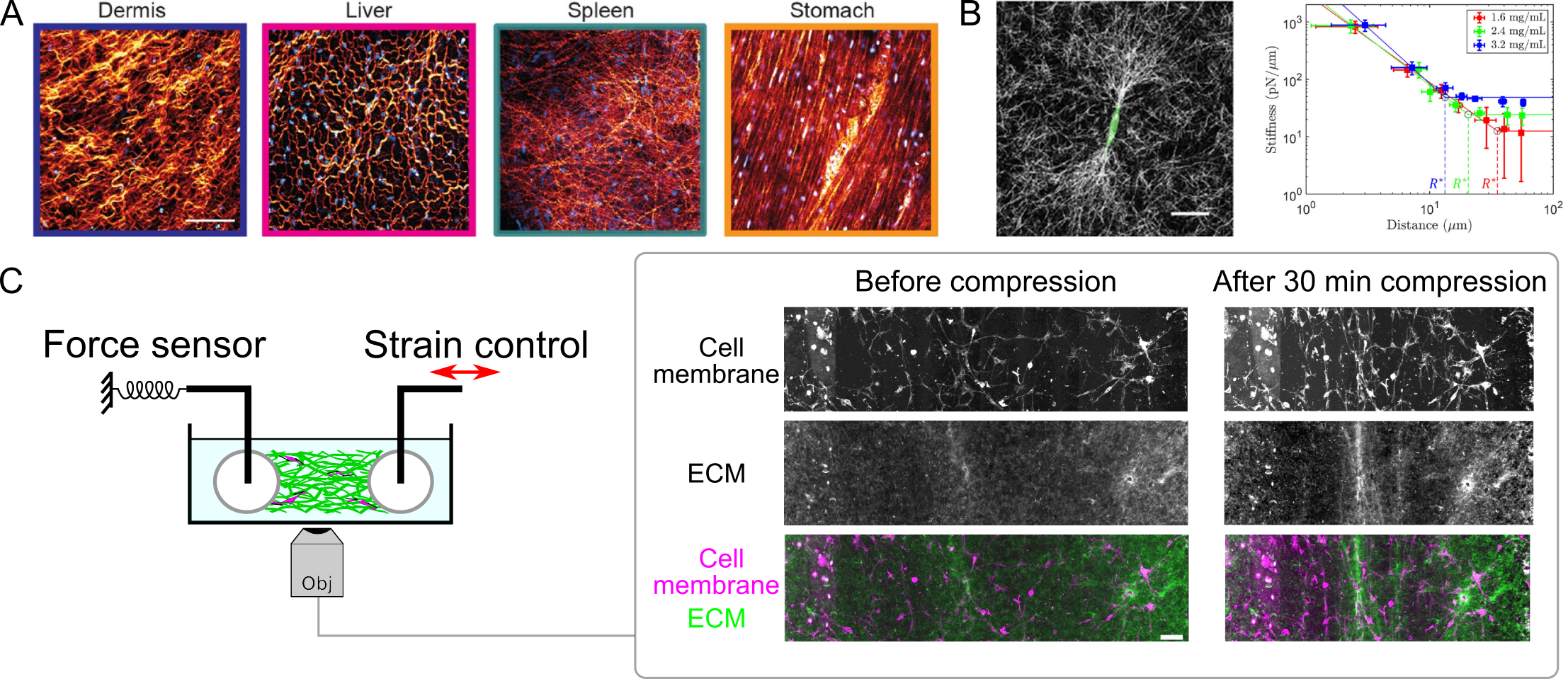 |
| Figure: (A) ECM (orange) organization and fibroblasts cells (blue) in various mouse organs (adapted from [Wershof et al, 2019]). (B) Left: Deformation of a collagen matrix (white) generated by cell traction forces exerted by a MDA-MB-231 cell (green). Right: Collagen matrix stiffness measured by optical tweezers as a function of the distance to the cell (adapted from [Yang et al, 2023]). (C) Left: Principle of the suspended fibrous tissue assay used in this project. Fibroblasts cells (magenta) are cultured in a collagen type I matrix (green) between two parallel rods. One rod can be displaced to apply controlled strain, while the other is connected to a force sensor to measure tissue stress. Right: Preliminary results showing the reorganization of ECM and fibroblasts of a suspended tissue in response to a step compression, imaged by confocal microscopy. This device will be used in Part 2 of the project. |
In a Master's internship, we will focus on the data analysis of how cells and the microstucture of collagen respond to transient compression. In a PhD project this study will be the basis to develop a kinetic model of statistical physics, inspired by previous work [4] and models of active gel models for cytoskeletal networks and molecular motors [5], and leading to a continuum-level mechanical model of active collagen network.
This project will benefit from an existing collaboration between researchers in physics of biological systems.
References
[1] E. Wershof, et al. “Matrix feedback enables diverse higher-order patterning of the extracellular matrix”. PLOS Computational Biology 15.10 (Oct. 2019).[2] I. Levental, et al. “Soft biological materials and their impact on cell function”. en. In: Soft Matter 3.3 (2007), pp. 299–306.
[3] A. Erlich, J. Etienne, J. Fouchard and T. Wyatt, How dynamic prestress governs the shape of living systems, from the subcellular to tissue scale, Interface Focus., 12(6):058101 (2022)
[4] Yang, H., Berthier, E., Li, C., Ronceray, Y. L., Broedersz, C. P., ... & Guo, M. (2023). Local response and emerging nonlinear elastic length scale in biopolymer matrices. Proceedings of the National Academy of Sciences, 120(23), e2304666120.
[5] A. Jallon, P. Recho and J. Etienne, Mechanics and Thermodynamics of Contractile Entropic Biopolymer Networks, J Elast 157(1):487 (2025)
Application details
The successful applicant will work under the supervision of Jocelyn Etienne at LIPhy (Interdisciplinary Laboratory of Physics – Grenoble, France) in the “MC2” team, in collaboration with Dr. P. Recho, Dr. K. John and Dr. A. Erlich. He/she will also interact strongly with Jonathan Fouchard (Laboratoire de Biologie du Développement, Paris-Sorbonne Fouchard).Email me to apply. Please include recent transcripts and relevant internship reports with your application.

Laboratoire Interdisciplinaire de Physique (LIPHY) is located in Grenoble. Grenoble is the unique conjunction of a well-established university city with world-class research groups, within a breathtaking mountain landscape. LIPHY is a Physics department, but is highly interdisciplinary with many mechanicists, applied mathematicians and biologists working there as staff, post-docs or graduate students.